Mir Photonics' Multispectral Laboratory of Optical Analysis Methods

“Mir Photonics” LLC has developed an innovative universal optical multispectral laboratory — a comprehensive collection of specially selected optical spectral equipment designed to solve a wide variety of scientific, educational, and industrial problems. The laboratory concept, described in detail in this paper, also features a new technique for spectral analysis based on an inter-spectral chemometric approach.

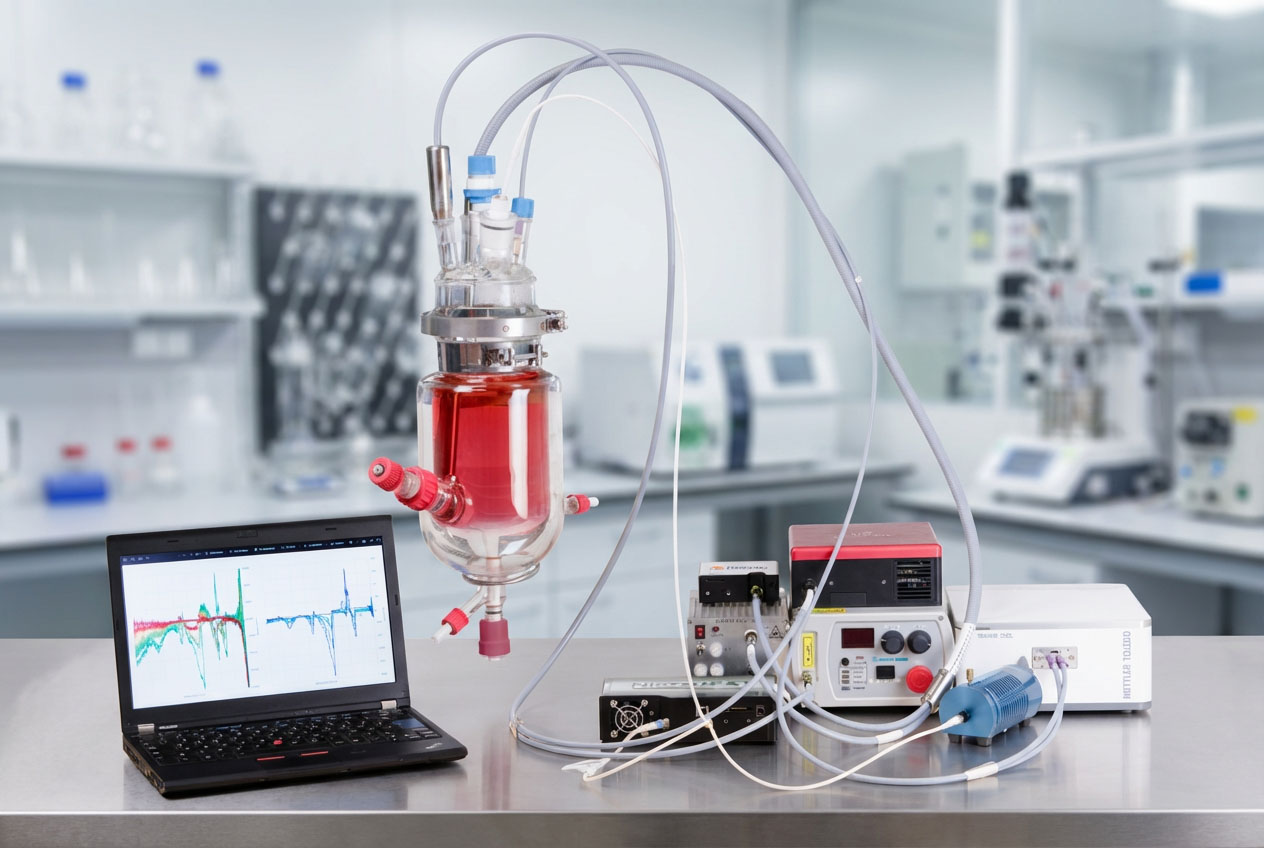
The laboratory is focused on modern analytical research, including the online analysis using fiber optic cables and probes.
The Power of Optical Spectral Analysis

Optical spectral analysis holds a special place among physicochemical methods for studying substances and materials. This method is based on measuring the result of the interaction of electromagnetic radiation with a sample across a wide range of wavelengths, from hard ultraviolet to far infrared light. Optical analysis is often the optimal choice because it is:

  • Fast.
  • Non-destructive.
  • Extremely flexible in organizing measurements.
  • Not requiring mandatory sample preparation.


A noticeable trend in optical spectroscopy is the increased use of fiber optic solutions. Fiber optic probes and cells can be built into reactors and production lines, enabling online analysis on site and providing results in near real time. Thanks to achievements in photonics, optics, and micromechanical engineering, the development of specialized analyzers, known as Optical Multisensor Systems (OMS), is actively underway.

Advantages of the Integrated Multispectral Approach

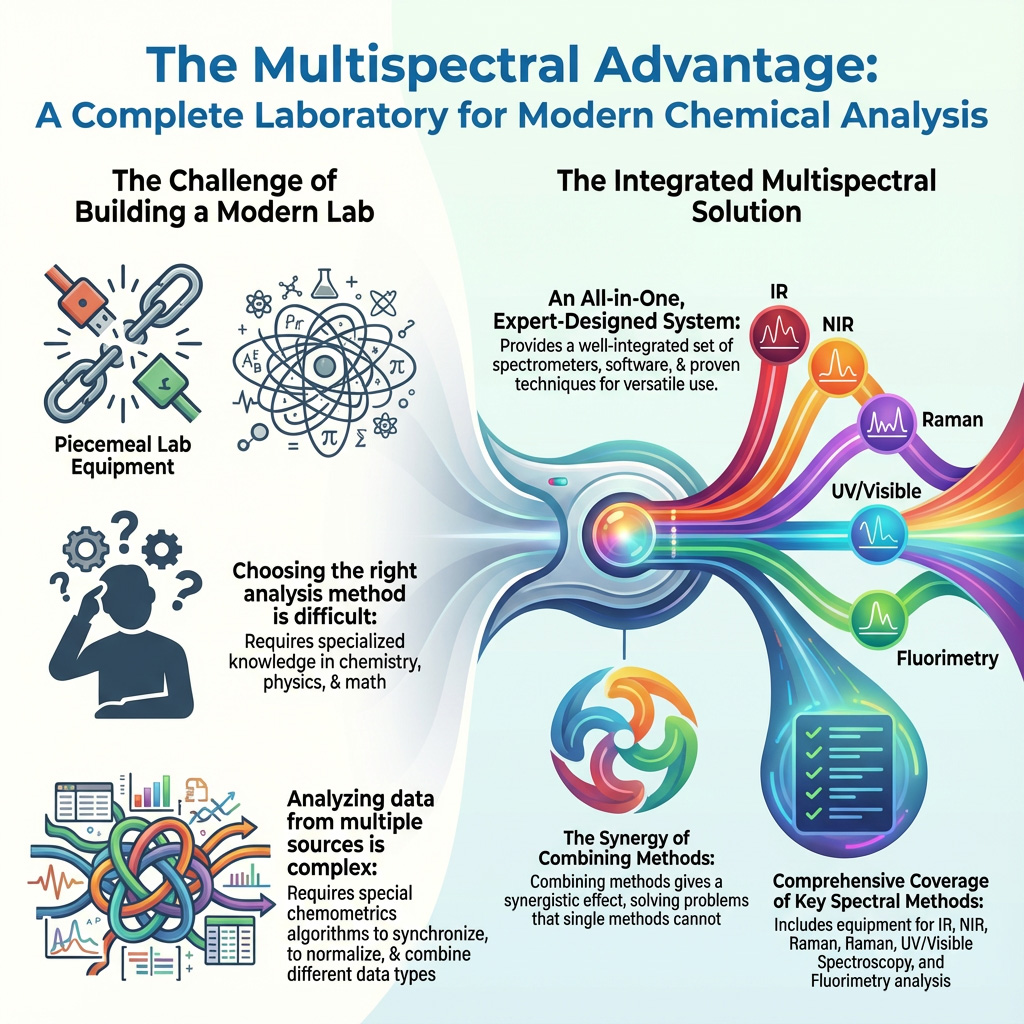
The ability to purchase an entire spectral laboratory at once, rather than element by element, provides significant benefits.

Synergy of Spectral Methods

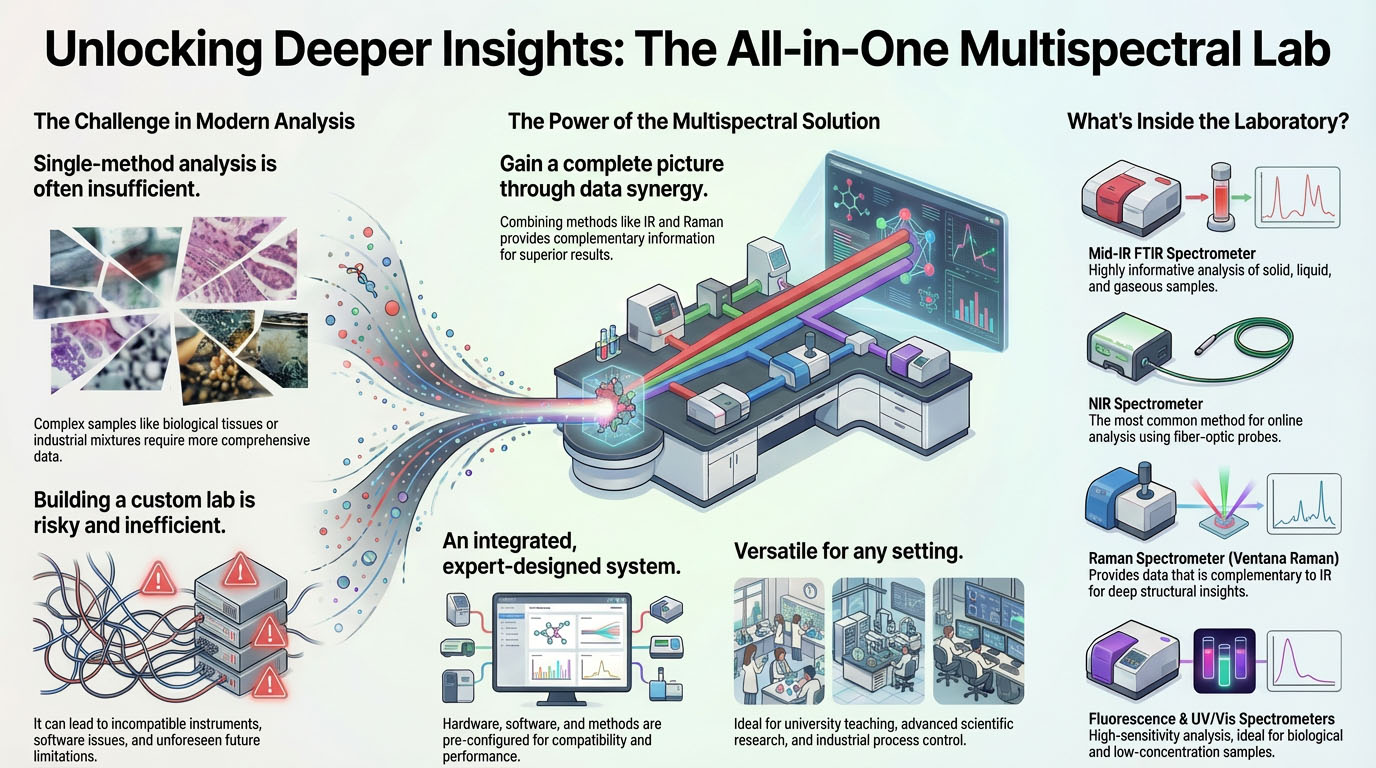
Different spectral methods provide information about the chemistry and morphology of the sample (concentrations, distribution, particle sizes), but this information can vary greatly. For complex, real-world samples — such as oil, milk, process media, or biological tissue — the information supplied by a single method is often insufficient due to the complexity of multicomponent mixtures or overlapping phenomena (absorption, scattering, fluorescence).

The multispectral optical analysis approach involves combining two or more spectral methods to achieve a synergistic effect, allowing for the solution of problems that individual methods cannot fully address. This synergy is based on combining heterogeneous information:

  • Complementary Chemical Information: For example, combining vibrational IR and Raman spectra provides more structural information.
  • Morphological Information: Relevant in the analysis of milk (particle size).
  • Depth Information: As seen in the analysis of biological tissue samples by IR and NIR spectroscopy using fiber-optic probes.


Examples of successful combinations include NIR spectroscopy with fluorescence spectroscopy for determining biomass content during yeast fermentation, and the combination of NIR and IR spectroscopy for determining tumor boundaries in medical diagnostics.
Optimized for Various Applications

The integrated laboratory set is pre-designed and well-integrated, taking into account the mutual compatibility of instruments and software.

Educational Use

The laboratory supports undergraduate, graduate, and postgraduate education in analytical chemistry, chemical ecology, pharmaceuticals, and food production, with optimized pricing, software tools, and ready-made lab examples that simplify setup.

Scientific Research

The presence of various optical spectroscopy approaches is crucial for exploratory research where it is difficult to predict in advance which method will be most effective. This flexibility is essential for analyzing natural and industrial samples of unknown composition.

Industrial Use

A comprehensive and well-balanced combination of spectral equipment and software reduces the cost and complexity of equipping new or modernizing existing industrial laboratories, especially for developing multispectral analytical techniques.

Raman Spectrometer

Method: Measures weak Raman scattering signals (vibrational spectroscopy).
Features: Provides information complementary to mid-IR spectra, offering more structural details when used in tandem. Designed for laboratory measurements and online analysis, it uses a powerful 785 nm laser source.

Mid-IR FTIR Spectrometer

Range: Mid-IR range (4000-400 cm⁻¹). Features: One of the most sensitive and informative chemical analysis methods. Accessories: Includes a complete accessory set for versatile sample analysis: ATR (diamond & ZnSe), liquid cuvettes, PRIZE unit for solid analysis, an ATR fiber-probe coupler for online measurements, and a gas cell.

NIR Spectrometer

Range: 780-1800 nm.
Features:
Most common method for online analysis using fiber-optic probes. Measurements are facilitated by the transparency of glass, low absorption coefficients, and high light scattering, making it ideal for online applications.

Hardware and Software Components

The multispectral laboratory is equipped with instruments covering a wide range of analytical needs, focusing on fiber optic interfaces and online measurements.


Spectrometer for Fluorescence Analysis

Range: 400-1100 nm (visible and short-wave NIR radiation).
Method: Based on measuring a wide emission signal when samples are irradiated, often used in biology, biotechnology, and online analysis of technological processes.

Thermogravimetric Humidity Analyzer

Function: Measures moisture by heating and drying the sample with a halogen lamp until constant weight, calculating the original moisture content. Can also simply weigh samples up to 120 g with high accuracy (± 0.003 g).

Chemometrics Software

Platform: TPT-cloud.
Function: Essential for creating predictive models based on spectral data using chemometrics methods and algorithms. As a modern “cloud” solution, it does not require installation and is accessible via any Internet browser. This cloud organization is a necessary element for distributed analyzers, such as Optical Multi-Sensor Systems (OMS).

UV and Visible Spectrometer

Range: 180-1080 nm.
Features: High spectral resolution (2.5 – 10 nm). The UV range (180-360 nm) allows for the analysis of small concentrations of substances (tens of mg/l) due to high molar absorption coefficients. It can also be used as an alternative for fluorescence spectra registration.

Our Partners

Let's Talk

Grow your business with us

Discuss your application, technical requirements, or collaboration ideas directly with our team. Schedule a short call to explore how our fiber technologies can support your research or industrial needs.